Why a baritone, not a detuned guitar.

Bacci GuitarsPescia, Tuscany
It is the obvious thought. If you want a lower sound, why not just tune a standard guitar down to B and save the cost of a baritone? Plenty of players try it, and plenty come away frustrated. The reason is physics, not preference: it comes down to scale length and string tension.
Understanding that one idea explains why a baritone exists at all, and why it is not simply a guitar with low strings.
A string's pitch depends on its length, its thickness and its tension. Tune a standard-scale guitar down and you slacken the strings: tension drops, and the low notes go floppy. They buzz, they fret out, the pitch wavers when you dig in, and the sound turns loose and woolly.
A baritone fixes this by lengthening the scale, the distance the string is stretched across. A longer scale restores the tension you lost by tuning down, so the same low pitch sits under firm, defined strings instead of slack ones. The note stays tight, clear and in tune.
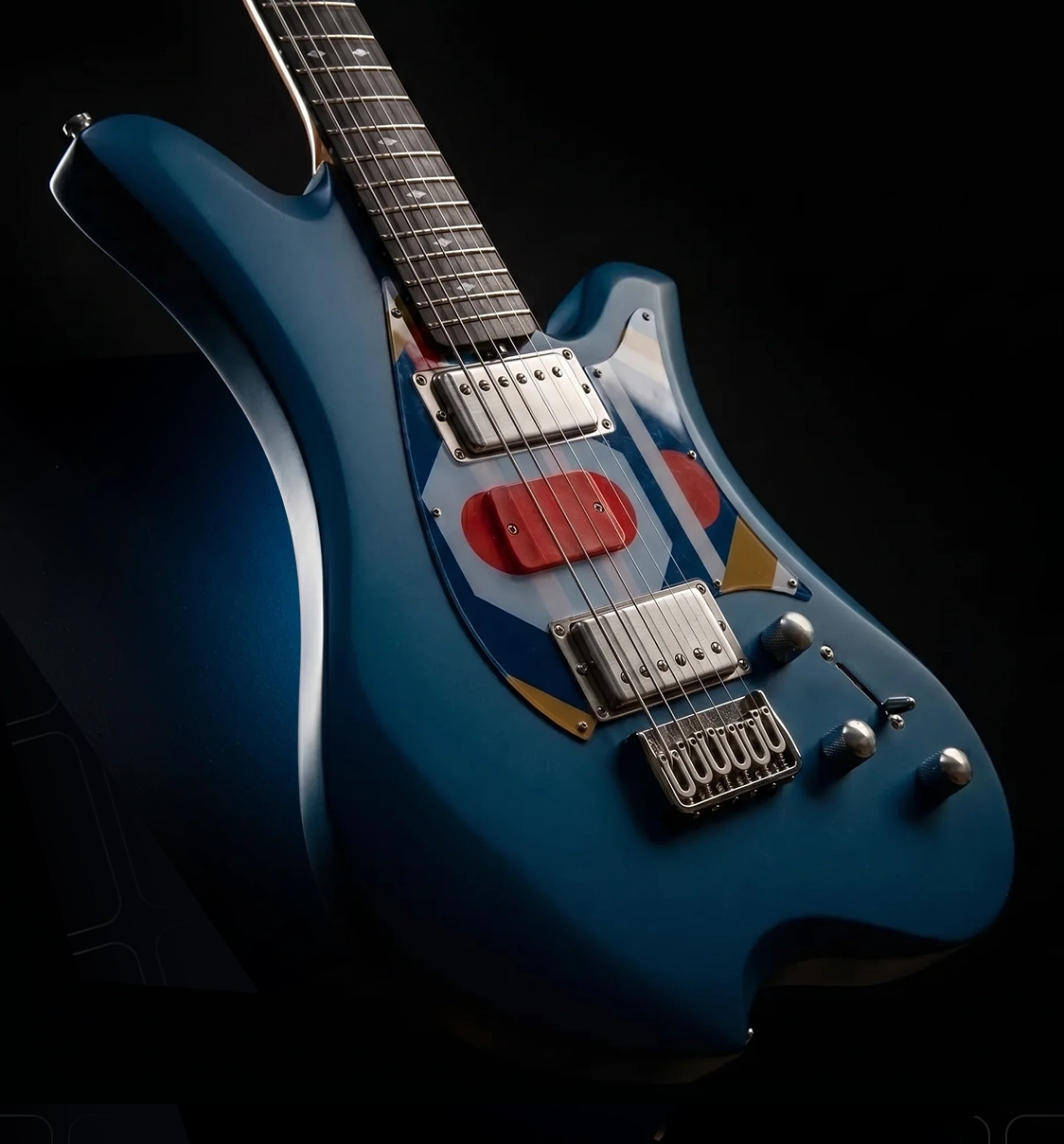
The Bacci Leonardo is a long-scale baritone, built so the low end stays tight and defined. Handbuilt to order in Tuscany.
In the hands, the difference is immediate. A detuned standard guitar feels rubbery in the low strings; a baritone feels firm and positive, so you can play with intention down there. Intonation holds, so chords ring true rather than sour.
In the sound, a baritone gives the low register definition. Each note speaks as a clear pitch with attack and body, which is exactly what you want whether you are chugging a riff or voicing a rich jazz chord. Scale length is the difference between a low note and a low note you can actually use.
Standard guitars sit around 25.5 inches. Baritones commonly run from 27 to 30 inches, and the extra length is what makes lower tunings work. More scale means more tension at the same pitch, which means a tighter, clearer low end.
The usual scale, happiest in standard tuning.
Long enough to keep B or A standard tight and clear.
For the deepest tunings, firmest low strings of all.
Because every Bacci is built to order, the scale length is not a fixed compromise but a decision. Bruno sets it, often around 28 inches, for the tuning and feel you are after, so the low end is tight and defined for your music rather than a general average.
That is the real answer to can't I just tune down. You can, but a baritone built to the right scale gives you the low register as a tool you can trust, note for note.
Because tuning a standard-scale guitar down slackens the strings, so the low notes go floppy, buzz and lose pitch definition. A baritone uses a longer scale to restore tension, keeping the same low notes tight and clear.
Scale length is how far the string is stretched. A longer scale gives more tension at the same pitch, which is why a baritone can tune low and still feel firm, while a short-scale guitar tuned low feels loose.
Baritones commonly run from 27 to 30 inches, against about 25.5 inches for a standard guitar. The extra length is what makes lower tunings tight and usable.
Heavier strings help the tension, but a short scale still limits how tight a low tuning can be, and very heavy strings change feel and can need a new nut and setup. A longer scale solves it properly.
Because every Bacci is built to order, the scale is chosen for your tuning and feel, often around 28 inches, so the low end is defined for your music rather than a general compromise.
A long-scale baritone, built to order so the bottom stays tight, clear and in tune. Not a detuned guitar, the real thing.
Every Bacci is designed, built and set up by Bruno, one at a time, in Pescia.