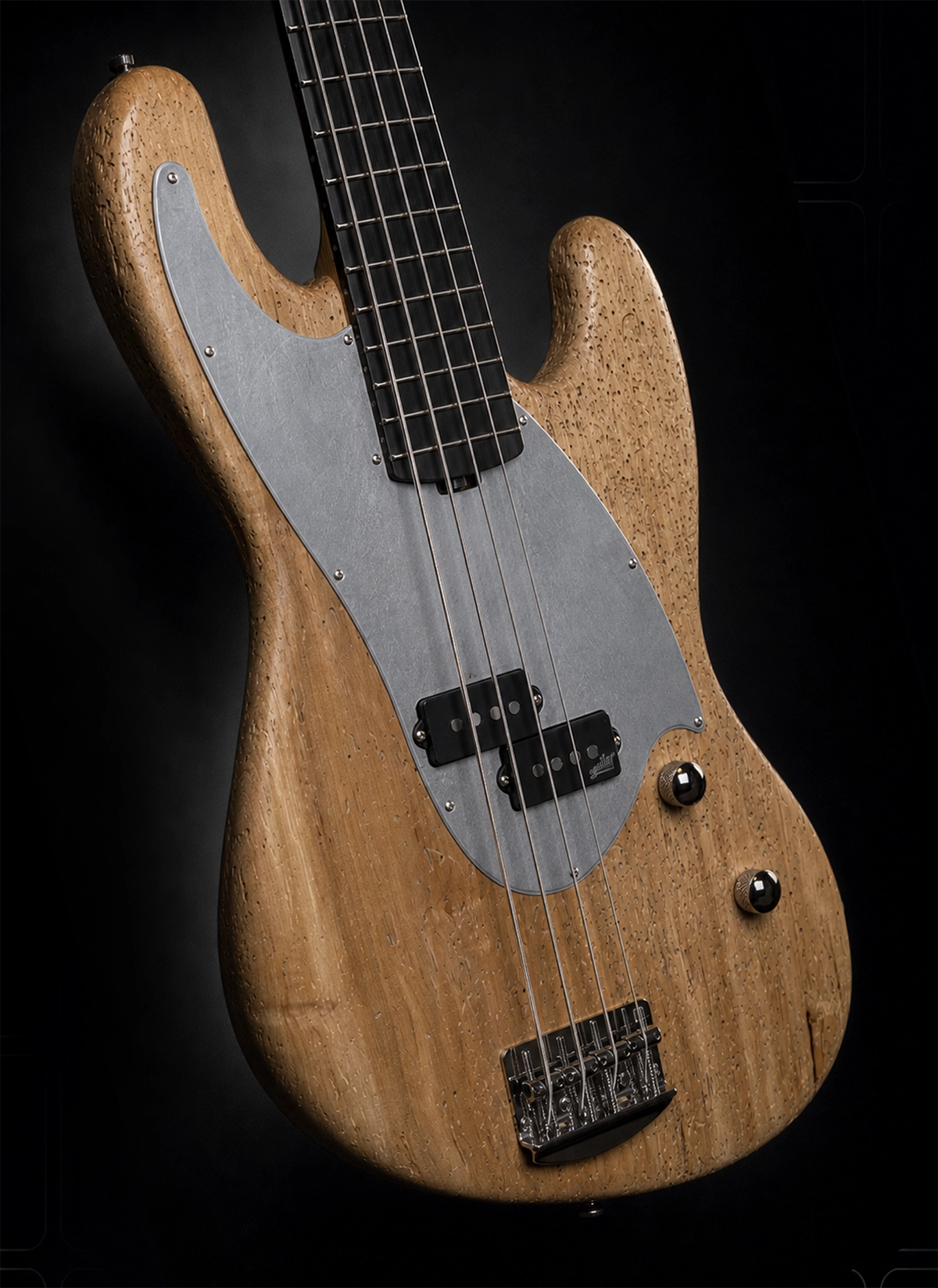
The bass for Jaco Pastorius.

Bacci GuitarsPescia, Tuscany
Before Jaco Pastorius, the electric bass held down the bottom. After him, it could sing, cry, solo and float. Playing a fretless Fender Jazz Bass with Weather Report and on records like his own debut, he brought harmonics, glassy melodies and a vocal, horn-like phrasing to an instrument nobody had asked to do any of it.
He did it on a passive bass, frets pulled out by his own hand, with nothing between the strings and the amp but his touch. The fretless fingerboard let the notes slide and bloom like a voice, and the passive circuit meant every nuance of his hands reached the listener unfiltered.
He was gone at thirty-five, another of music's great what-ifs. And the instrument his sound points toward is a passive bass that gets completely out of the way, which is a Bacci.
A bass with nothing between the strings and the amp, so the hands sing.
Jaco's genius needed an instrument that would report his hands faithfully, every slide, every harmonic, every dynamic shift. A passive bass does exactly that: with no preamp compressing or colouring the signal, the amplifier's full response stays in your hands, and the smallest change in your touch is heard.
That is the heart of the Marleo. Bruno builds it around the idea of only what is necessary, a passive circuit, a figured maple neck hand-matched to its own body, and nothing in the way of the player. For a musician who turned touch into melody, there is no higher design goal.
How a passive circuit keeps every nuance of your hands in the sound.
The one thing Jaco could not buy off a wall he made himself, by pulling the frets from his Jazz Bass. He had to modify a factory instrument to reach his voice. A Bacci starts from the other end: because every one is handbuilt to order, the fingerboard, the scale, the voice and the feel are chosen before the first cut, including a fretless fingerboard for that singing, vocal character.
It is the difference between adapting an instrument to a vision and building an instrument from the vision outward. Jaco did the first, brilliantly. The Marleo is made to do the second.
He turned touch into melody. The right bass simply refuses to get in the way of that.
On Jaco PastoriusThis is an homage, not a claim. Jaco made history on a Fender he modified himself, and that story needs no edit. But if we ask what his documented sound points toward, it is a passive bass that disappears behind the hands, built to the exact specification, fretless or not, that the player's voice demands.
A Bacci Marleo, in other words. Handbuilt to order in Tuscany, so the instrument vanishes and only the singing is left.
Passive, fretted or fretless, in your scale and voice. Built around you.
Jaco Pastorius was the bassist who redefined the electric bass as a lead and solo instrument. Playing a fretless Fender Jazz Bass with Weather Report and on his own records, he brought harmonics, singing melodies and a vocal, horn-like voice to the instrument. He died in 1987, at thirty-five.
A fretless Fender Jazz Bass, a passive instrument, from which he had removed the frets. His sound relied on the fretless fingerboard, his touch, and natural harmonics, with no active electronics in the way.
His voice was a passive bass with nothing between the strings and the amp, played with a touch so expressive it sang. The Bacci Marleo is a passive bass built around exactly that directness, handbuilt to order, including to a fretless specification, so the instrument disappears and the hands sing.
Every Bacci is handbuilt to order, so the specification is yours, including the choice of a fretless fingerboard for a singing, vocal voice in the Jaco tradition.
No. This is an homage, our view of the instrument Jaco Pastorius's documented sound points toward, not a claim that he played or endorsed one.
Yes. The Marleo is handbuilt to order in Tuscany, passive, to your scale, strings, fingerboard and finish. You can start from the Marleo page.
A passive Marleo, handbuilt to order in Tuscany, fretted or fretless, so your touch does the singing.
Every Marleo is designed, built and set up by Bruno, one at a time, in Pescia.