How a commission works.

Bacci GuitarsPescia, Tuscany
Commissioning a handmade instrument sounds daunting from the outside, as though you need to arrive with a full specification in hand and get every decision right before a single cut is made. You do not. A Bacci starts with a conversation about the music you actually play, and the instrument is drawn around that, one decision at a time.
There is no production line and no showroom. Each instrument is made to order, voiced, adjusted and finished by Bruno himself, in Tuscany, which is exactly what makes the process a dialogue rather than a transaction. You are not picking from a shelf, you are describing a sound and watching it take shape.
This article walks through how a commission actually works, from the first conversation to delivery, what you choose along the way, what it costs in broad terms, and how to order with confidence even from the other side of the world.
Tell Bruno what you play, and the instrument is built around it.
The path is the same for every build, and each step is a decision rather than a wait. Understanding the three stages takes most of the mystery out of ordering.
A deposit holds your place at the bench and sets the work in motion. It is not an extra fee, it comes off the final price in full. This is the point where an idea becomes a build in the queue.
Woods, pickups, finish, scale and strings, decided one by one, with Bruno. The instrument is drawn around you, including the options considered and set aside. This is where the specification is written, and it is the heart of the commission.
The balance falls due once the specification is closed. Then the build runs, voiced and set up by Bruno, and the finished instrument is yours, backed for life.
A commission is a series of choices made in order, each one narrowing the instrument toward you. The scale, which sets the feel and the register. The string count, four or five on a bass, six on a guitar. The pickup voice, the character of the sound at its source. The woods, chosen by Bruno for voice and grain. The fingerboard, the hardware, the finish.
None of these is a drop-down to fill in alone. Each is discussed, because each affects the others, and because the point of a commission is that the decisions are informed by the maker who will live with them at the bench. The ones you set aside matter too: knowing why a choice was not made is part of understanding the instrument you end up with.
The honest hesitation with any commission is the same, and it is reasonable: you cannot play your own finished instrument before it exists, and it is being built across an ocean by someone you may have met once. What a good commission does is remove the uncertainty from that, by settling every decision early, in the conversation, well before anything is cut.
You can play the model, as many players do, before you commission your own. You agree the scale, the voice, the woods and the finish. By the time the build runs, nothing about it is a surprise. And if you would rather not do it entirely at a distance, you do not have to.
What this commission shows is that all of it is settled early, in the conversation, well before anything is cut.
On ordering a BacciFor a few players each year, the Bacci Experience opens the workshop doors. You join Bruno for the final stages of your build, choose the last details by hand, and are the first person ever to play your instrument. It is three days in Tuscany, at the bench, at the table, and in the hills, and only four are offered each year.
It is the clearest expression of what a Bacci commission is: not a purchase completed at a distance, but an instrument finished alongside the person who made it. For many owners it is the part they remember most.
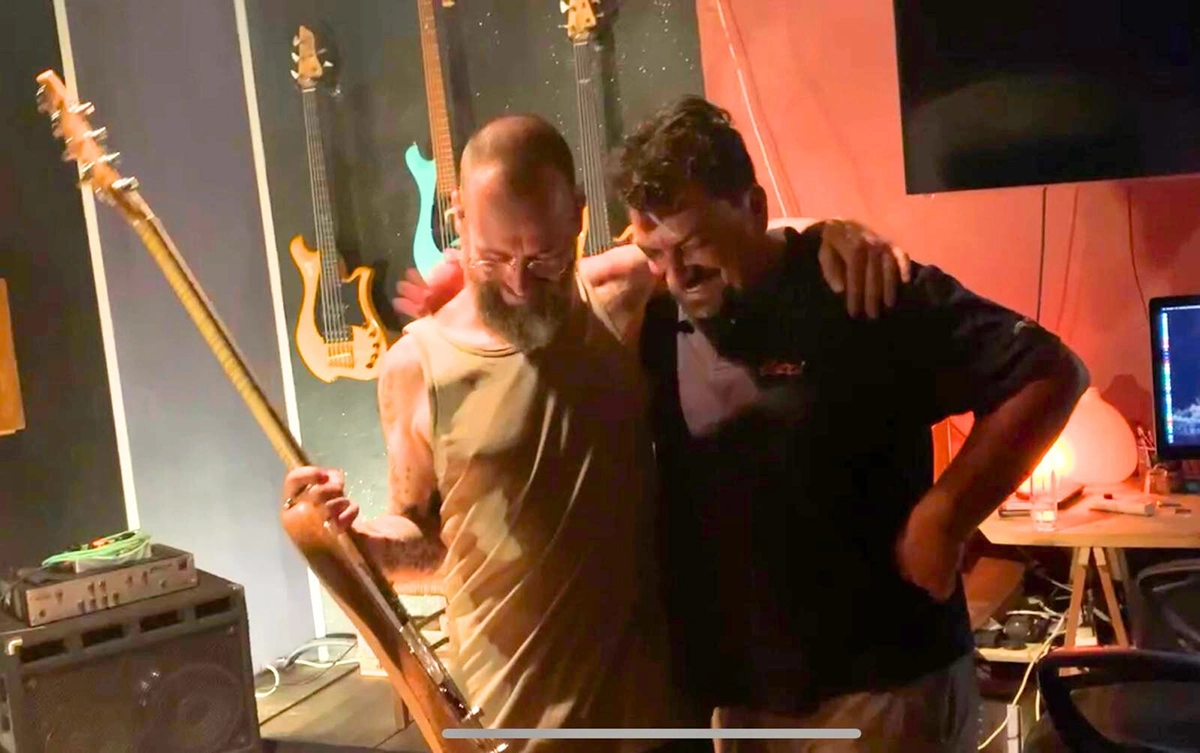
Every Bacci is handbuilt to order in Tuscany. It starts with a conversation, not a form: you tell Bruno what you play, you settle the scale, strings, pickups, woods and finish together, a deposit holds your place at the bench, and the balance falls due when the specification is closed.
It depends on the model and the specification. A deposit holds your place at the bench and sets the work in motion, and it comes off the final price in full. The balance is due once the specification is closed, before the build runs.
It varies by model. A made-to-order instrument is built after the specification is settled, and the Tosca, as a limited edition, is built in eleven months. Bruno gives you the timing for your build when you order.
Scale, string count, pickup voice, woods, fingerboard and finish are all chosen when you order. The instrument is drawn around you, one decision at a time, with Bruno, including the choices you set aside and why.
No. You do not need to arrive with a full specification. A Bacci starts with a conversation about the music you actually play, and the instrument is built around that. The decisions are made together, in order, as the build takes shape.
Yes, through the Bacci Experience. For a few players each year, Bruno opens the workshop so you join him for the final stages of your build, choose the last details by hand, and are the first person ever to play your instrument.
It is a fair worry, and the answer is that everything is settled early, in the conversation, well before anything is cut. You cannot play your own finished instrument before it exists, but you can agree every decision that shapes it, and many players travel to finish theirs in person.
Yes. Every Bacci is backed for life by a lifetime warranty from Bruno himself.
Nothing here is in stock, and nothing ever will be. Every instrument is claimed by one player before the first cut. It starts with a conversation.
Every Bacci is designed, built and set up by Bruno, one at a time, in Pescia.