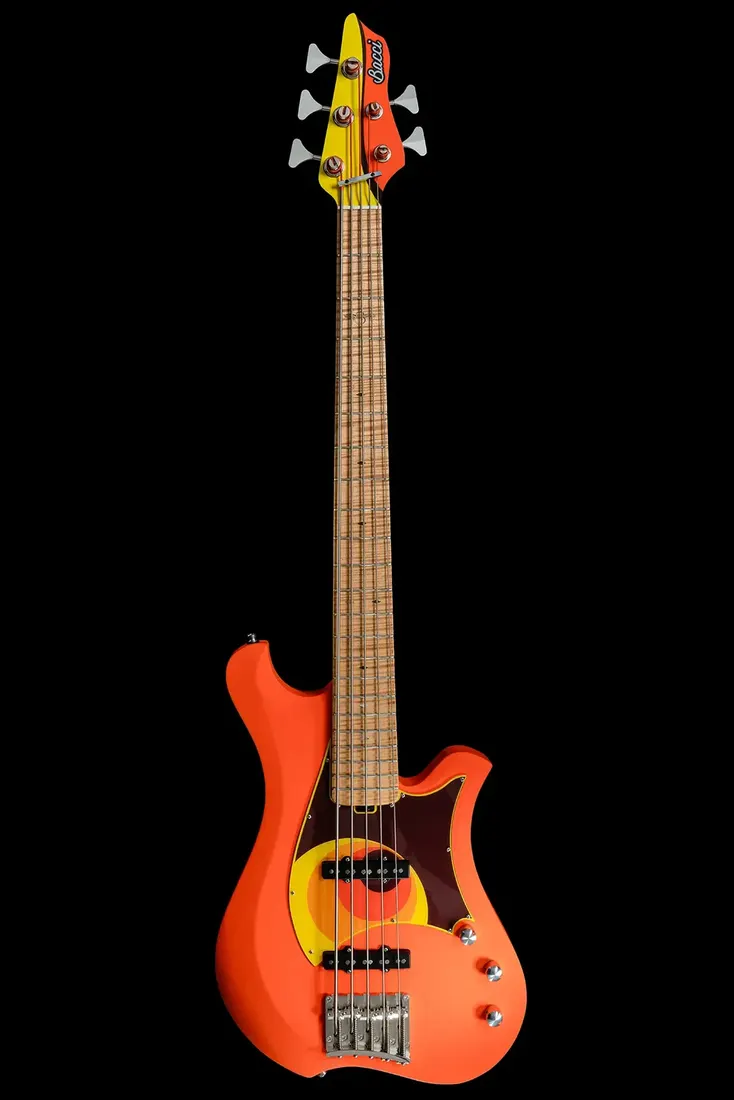
When an instrument becomes art.

Bacci GuitarsPescia, Tuscany
Most guitars are finished to look like guitars: a colour, a burst, a gloss. An art finish starts from a different question, what if the surface were a canvas? The instrument keeps every bit of its playability, but its face carries a composition, a pattern, a piece of design, so it reads as an object as much as a tool.
It is a small but real category, and it is central to how Bacci thinks. Two of the workshop's collections, Parato and Art of Nature, are built entirely around the idea that a finish can be the reason you fall for the instrument.
The Parato collection returns to the iconic Italian design language of the 1970s: bold geometry, confident colour, patterns that feel printed yet are built up by hand. Rhombuses, waves, circles and slaloms in coral, navy, teal and warm cream, each one a finish you could hang on a wall.
Parato is offered on the Marleo bass and the baritone, so the art is not a limited novelty but a way to order the instrument you actually play. The playing surface is a guitar; the face is a graphic object.
Parato's 1970s art finishes and the grain-led Art of Nature, both built by hand onto instruments you play.
Where Parato is graphic and bright, Art of Nature looks the other way, to the material itself. Here the finish reveals rather than covers: walnut, olive and figured woods treated so the grain becomes the composition, the instrument's beauty coming from what it is made of.
The two collections are two answers to the same belief, that the surface of an instrument deserves as much thought as its voice. One paints; the other uncovers.
An art finish changes the relationship you have with an instrument. It is the thing on the stand you keep glancing at, the piece a photographer frames, the detail an audience notices from the third row. For a player whose instrument is part of their identity, that matters.
It is also, quietly, a positioning that almost no one owns. Plenty of builders offer a nice top or a custom colour. Very few treat the finish as design, by hand, as a named collection. That is the space Bacci lives in.
It is an instrument whose finish is treated as a piece of design or art rather than a plain colour or burst. The playability is unchanged; the surface carries a composition, pattern or revealed grain so the instrument reads as an object.
Parato is a collection of 1970s-inspired Italian art finishes, bold geometric patterns in confident colour, built by hand and offered on the Marleo bass and the baritone.
Art of Nature is Bacci's grain-led finish approach, using woods like walnut and olive treated so the natural figure becomes the instrument's visual composition.
No. The finish is about the surface. The neck, scale, electronics and setup determine how it plays and sounds, and those are built to order independently of the finish you choose.
Yes. Because every Bacci is handmade to order, finishes are chosen when you commission the instrument, and custom directions can be discussed with Bruno.
Parato's 1970s art finishes and Art of Nature's revealed grain, built by hand onto the instrument you play. Commissioned directly with Bruno in Tuscany.
Every finish is built by hand onto an instrument designed, voiced and set up by Bruno.